
Clinton ZIP Code Coverage
52732 serves physical Clinton addresses and the Clinton Post Office. That is the confirmed code. PO-box mail runs under 52733 instead. Older USPS Domestic Mail Manual tables list 52736 as historical Clinton coverage. Current postal listings do not carry it. Treat claims for 52734 and 52771 as unverified. An address-level USPS result should show a Clinton location first.
| ZIP Code | Areas Covered | Post Office | Notes |
|---|---|---|---|
| 52732 | Confirmed physical Clinton addresses | Clinton Post Office | Use Clinton address lookup for ZIP+4 |
| 52733 | Clinton government mailing and PO-box use | Clinton mailing convention | Does not map to a residential block |
| 52736 | Historical Clinton listing | Historical USPS DMM | Verify current service before use |
ZIP exists to route mail. It does not settle residence or jurisdiction. A residents directory has to respect that limit. The ZIP code directory therefore splits confirmed physical service, PO-box use, and historical evidence into separate rows. That split keeps a 52733 mailing address from being plotted as a neighborhood. It also stops an old 52736 reference from quietly turning into current fact.
Verify a Clinton ZIP
Start with the USPS ZIP Code Lookup by complete Clinton street address. City-and-state mode gives only a rough answer. Address mode returns the deliverable code plus the ZIP+4. Before reading a no-match as final, recheck spelling, directional prefixes, apartment or unit data, and whether the address is physical or a PO box.
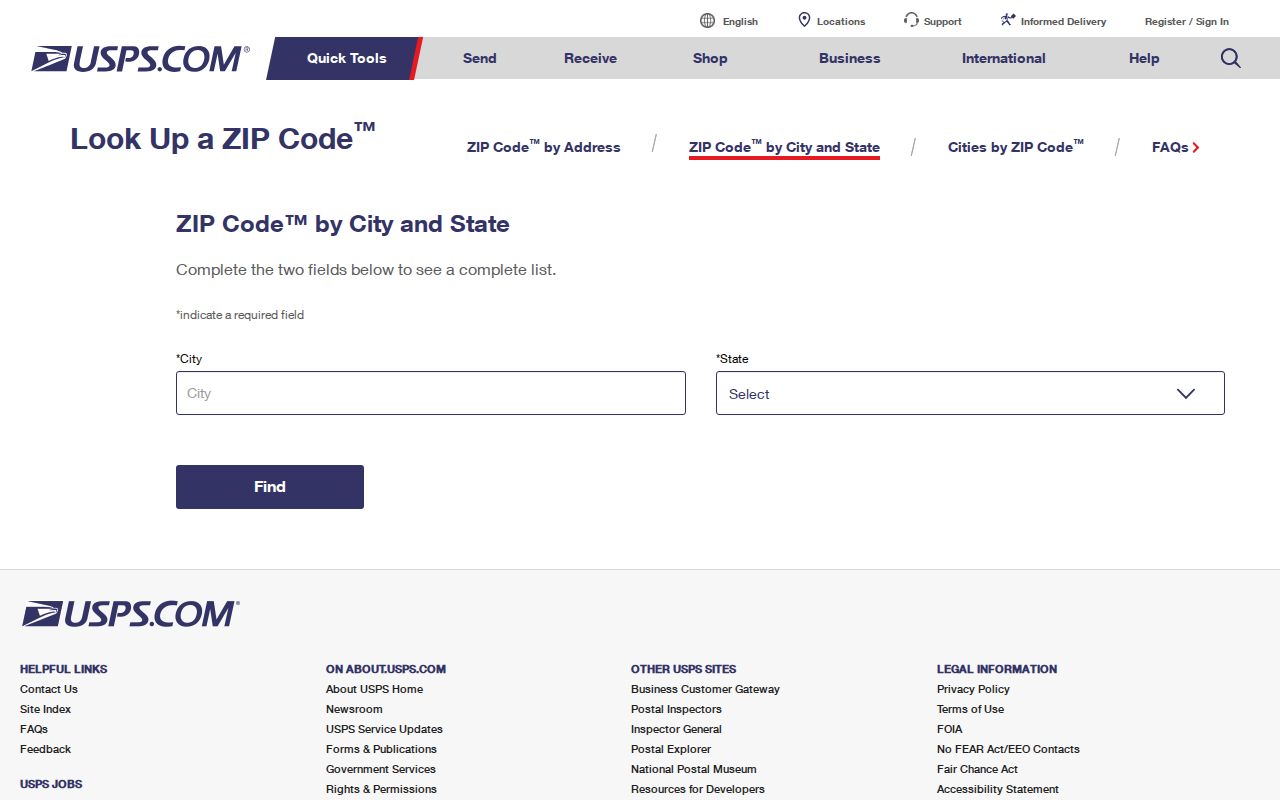
The USPS lookup page shows current postal service for any Clinton address. It says nothing about city limits or parcel ownership.
Clinton Records Accepting ZIP
Use a ZIP only where an official search offers the field. Iowa's voter-status form and the state professional-license search accept one. Clinton's assessor and Iowa Land Records do not. They query address, city, owner, legal description, or party name. A forced ZIP can bury useful results.
| Official search | ZIP field | Other needed fields |
|---|---|---|
| Iowa voter status | Required | First and last name, house number, full birth date |
| Professional licenses | Available | Name, board, city, status, or license number |
| Clinton Assessor | Not captured | PIN, owner, Clinton address, city, legal description, block or lot |
| Iowa Land Records | No ZIP mode | Grantor, grantee, date, document type |
A ZIP can narrow a statewide list. It still cannot replace the legal land key that the Recorder or Assessor relies on.
Read Clinton Address Fields
A parcel report usually shows a situs address, a mailing address, an owner, a parcel identification number, and a legal description. The situs marks the property's physical spot. The mailing field is where tax and official mail travels, sometimes a PO box or an address outside Clinton. Neither field alone proves who occupies the building.
- Situs Clinton address
- The physical location assigned to a parcel.
- Mailing Clinton address
- The delivery Clinton address used for notices, which may differ from the site.
- Legal description
- The lot, block, subdivision, or survey description that identifies land.
- PIN
- The county parcel identification number used to join map and assessment records.
Compare those fields before treating a postal match as a resident match.
Old Clinton Place Labels
Historic lookups need more than a modern ZIP. Bartlett's 1836 plat was called New York. The Iowa Land Company replatted the area in 1855. Lyons stayed a separate place until annexation in the 1890s, and a 1901 or 1903 directory entry may carry (L) for Lyons. Those old terms often unlock a directory, deed, newspaper, or plat when a postal search comes up empty.
Rural Clinton County adds section-township-range descriptions beside the city grid. The 1830s government survey field notes are not scanned. The County Auditor's Plat Room holds them. Start from the modern parcel PIN or legal description, then ask the Auditor for the relevant survey material instead of guessing from ZIP geography.
Clinton ZIP Record Handoffs
A postal code is a filter, not an answer. Suppose a name and ZIP return a voter-status match. Save the precinct and polling-place result, then check the house number against the county property system only when ownership itself matters. A professional-license hit tied to a Clinton ZIP deserves equal patience. Read the board, credential status, license number, and public business Clinton address before deciding what connection it shows. That address may mark an office, not a home.
Property research runs on a different track. Vanguard accepts owner, Clinton address, PIN, legal description, block and lot, section-township-range, city, and acreage. Beacon adds mapped parcel context. Iowa Land Records then searches recorded instruments by grantor, grantee, recorded date, document type, and image availability. None of those systems depends on a ZIP-wide search, so carry the exact street Clinton address or parcel key forward instead, because the postal code reaches none of these records.
When a portal returns nothing, call the matching custodian. The Assessor and Auditor/GIS offices can clarify current parcel or map fields. The Clinton County Recorder land-record office can search books and indexes held in the office, including material older than the practical 1986 online cutoff. USPS settles present mailing service. A no-match in one portal only describes that portal's fields and coverage. It never proves a resident was absent.
Note: Record the lookup date, because postal service, assessment cards, districts, and public portal screens can all change.
A mail label can also lag behind a change in how a place is described. Keep the label exactly as printed. ZIP+4, unit, directional word, and PO-box number all matter. A current USPS answer establishes present delivery, while an older directory, tax notice, or court filing shows the Clinton address used when that Clinton record was made. Both can be accurate for their own dates.
Clinton's city and county identities need the same care. Clinton is the county seat. The county holds 18 townships and 14 communities. A Clinton record stamped with that word may point to the city, the county, the post office serving a Clinton address, or the office that kept the record. Read the Clinton, township, ward, precinct, and legal-description fields directly instead of letting the ZIP stand in for all of them. Never treat the postal code as the whole answer.
The county administration building concentrates the Assessor, Auditor/GIS, Recorder, Treasurer, and election contacts in one place. That makes an offline fallback practical. Bring the exact Clinton address, owner spelling, PIN, document date, and whatever result or error appeared online. Staff can then route a parcel question, plat question, recorded-instrument request, or election-geography issue to the right records office. Ask about fees and copy format before ordering.
Historic evidence needs its own date trail. The county's archival land series reaches to 1840, well before modern ZIP codes. Old names carry real clues. State Historical Society holdings, library directories, Sanborn maps, and town-lot books organize places by town, street, owner, book and page, or legal description. Converting those entries into a modern postal code too early can conceal Lyons, New York, or rural survey wording. That wording often leads to the next source.
Use the ZIP code directory as a controlled translation layer. Keep the original term in one column. Put the verified current postal or parcel term in another. Cite the source and date for each pairing. The habit shows whether 52732 came from USPS, whether 52733 came from a PO-box mailing Clinton address, or whether 52736 came from an older postal table that still needs present-day confirmation.
Do not discard an unmatched Clinton address until the basic format has been checked. Formats fail more often than facts. Test the full directional, street suffix, unit, and city spelling through USPS. Compare situs and mailing forms next. If the Clinton record is old, test Clinton and Lyons plus the historic street wording. Log every variation. A later match can then be tied to the exact search that produced it.
Search Clinton Residents by ZIP
A ZIP code directory narrows the field. The final match needs an anchor. That anchor might be a name, house number, or parcel. The state voter lookup is an exact confirmation form, the professional-license portal filters public credentials by ZIP, and property and deed systems demand Clinton address or land record fields instead.
- Verify the complete Clinton address through USPS.
- Use the exact ZIP, house number, name, and birth date in the Iowa voter-status form.
- Search a public professional credential by city or ZIP when that is the relevant link.
- Move to Clinton address, parcel, or legal-description fields for property records.
Once a postal area narrows the search, the Clinton street directory explains the street-level property and deed path. Keep participation data, protected addresses, and ballot choices separate. Iowa voter-list rules offer no casual household roster.
Clinton ZIPs and City Limits
A Clinton ZIP boundary is not the city line. It is not the county boundary, ward, precinct, school district, or parcel either. Current local records can show a 52732 physical Clinton address, a 52733 PO box, one of four wards and eight precincts, and a separate legal description for one matter. Use Clinton map or GIS for jurisdiction. The auditor handles election geography, and USPS settles delivery.
- ZIP versus ZIP+4
- A five-digit delivery area versus the more precise nine-digit delivery code.
- PO-box ZIP
- A code used for mail collected at post-office boxes, not a residential block.
- Unique ZIP
- A code assigned to one high-volume recipient; none was verified for Clinton.
- Carrier route
- A postal delivery path that can cross other civic boundaries.
Boundary check. Never infer city residence, ward, ownership, or parcel limits from a Clinton ZIP alone.