
Clinton Address History by Era
Clinton previous residents are found by joining Clinton sources made for different purposes. The Clinton County Assessor and Beacon establish today's Clinton parcel key. Iowa Land Records and Clinton County Recorder books follow recorded ownership. Clinton directories and census schedules can identify occupants, including people who did not own the Clinton property. Clinton Sanborn maps and permits describe the building, while Clinton newspapers and probate material may explain a household's departure.
| Source | Years It Covers | Where Held | What It Shows |
|---|---|---|---|
| Assessor and Beacon parcel card | Current; land-history notice from 1986 | County Assessor and GIS hub | PIN, holder, situs, legal description, deed reference |
| Iowa Land Records | Generally 1986 forward online | Recorder and ILR Search 2.0 | Grantors, grantees, dates, document type, images |
| Town-lot and deed books | Land 1840-1902; town lots 1840-1900 | Recorder and SHSI | Earlier ownership by legal description |
| Clinton city directories | Catalog evidence 1901/02-1960, with gaps | Library, catalog reels, FamilySearch | Dated names, addresses, and family clues |
| Federal and Iowa census | Open schedules vary | Library and archives | Households at the enumeration date |
| City permit files | City Clerk archive reaches 2008 | Building Safety and City Clerk | Project, issue date, inspections, final status |
Start with the newest reliable Clinton record and move back one link at a time. For a recent Clinton transfer, use the parcel card and ILR. Before the Clinton online cutoff, shift to Recorder books, Auditor transfers, SHSI, and FamilySearch microfilm. For Clinton occupancy, ask the library which directory editions or address-first sections survive around the target year.
Anchor Clinton Previous Residents Today
The current Clinton parcel is an anchor, not the whole answer. Search the Clinton County Assessor by Clinton house number and street, then copy the PIN, deed holder, situs address, legal description, block and lot, and deed reference. Situs means the Clinton property's physical location. A mailing address is where Clinton County assessment notices go and may point to a trust, representative, or owner elsewhere.
The Clinton County property hub links the Clinton Assessor, Beacon reports, and GIS map. Its source screen shows the official Clinton handoff among those tools.
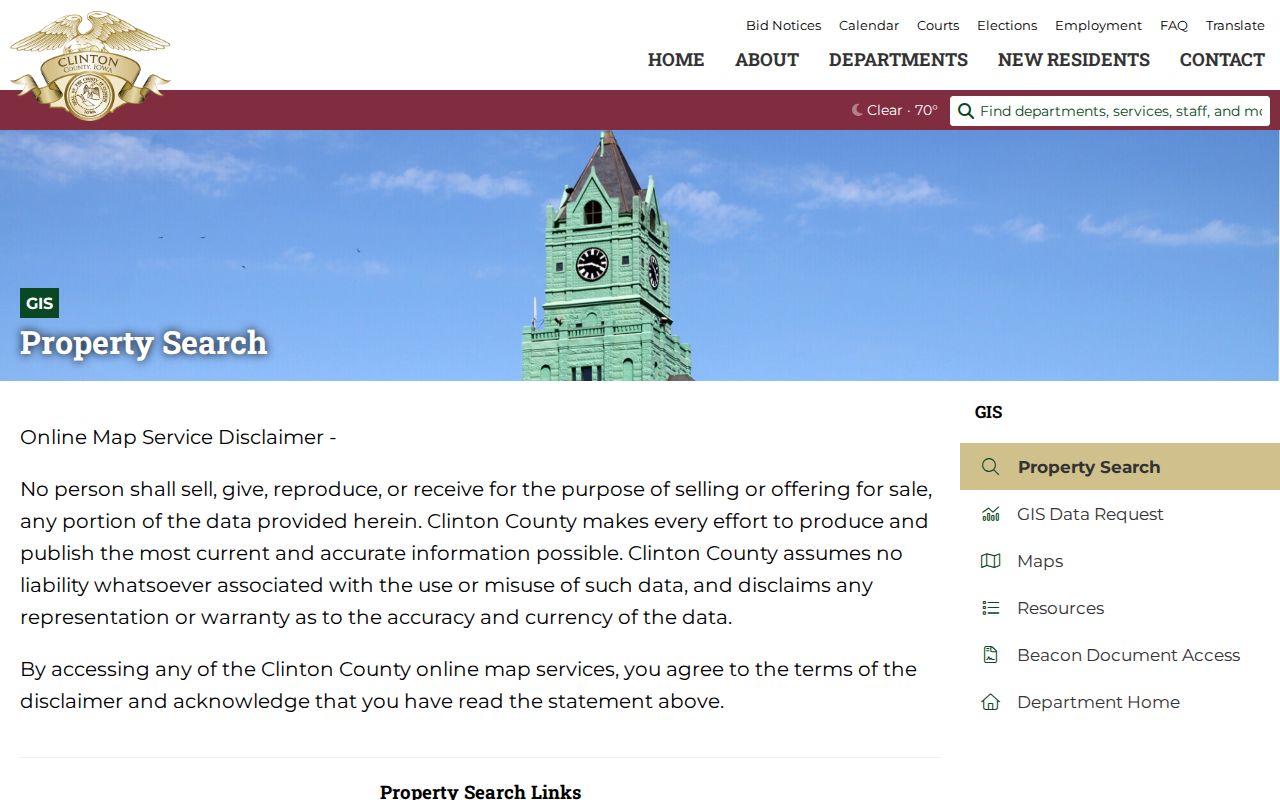
A Clinton Assessor card is not a title opinion or an occupancy list. Use its recording reference to enter the Clinton deed index, and use Clinton directories or census schedules to decide who actually lived there.
Keep the Clinton parcel fields separate. The situs address describes the Clinton property's physical location. The mailing address is used for Clinton County correspondence and may lead outside Clinton. A PIN is a Clinton administrative parcel key, while a legal description identifies the Clinton land through a lot, block, subdivision, or section-township-range form. Copy all four fields before following Clinton previous residents because older Clinton deeds may omit the modern street number entirely.
Trace Clinton Previous Residents in Deeds
A Clinton chain of title is the linked run of recorded transfers for one Clinton property. In Iowa Land Records, the grantor transfers an interest and the grantee receives it. Clinton names alone are risky. Match the instrument number, date, Clinton parcel or legal description, and document type at every step.
- Copy the current holder, PIN, legal description, and recording reference from the Assessor or Beacon report.
- Open that instrument in ILR. Record the grantor, grantee, date, document type, image status, and exact land description.
- Search the seller as a grantee to locate the deed by which that party acquired the same property.
- Repeat the link, testing initials, spouse names, trusts, entities, and spelling variants while holding the land description steady.
- At the 1986 boundary, use the Recorder, Auditor transfers, SHSI series, and FamilySearch microfilm.
- Grantor and grantee
- The transferring party and the receiving party named in a recorded instrument.
- Chain of title
- The connected sequence of deeds and other instruments affecting one property.
- Legal description
- The lot, block, subdivision, or section-township-range description that survives address changes.
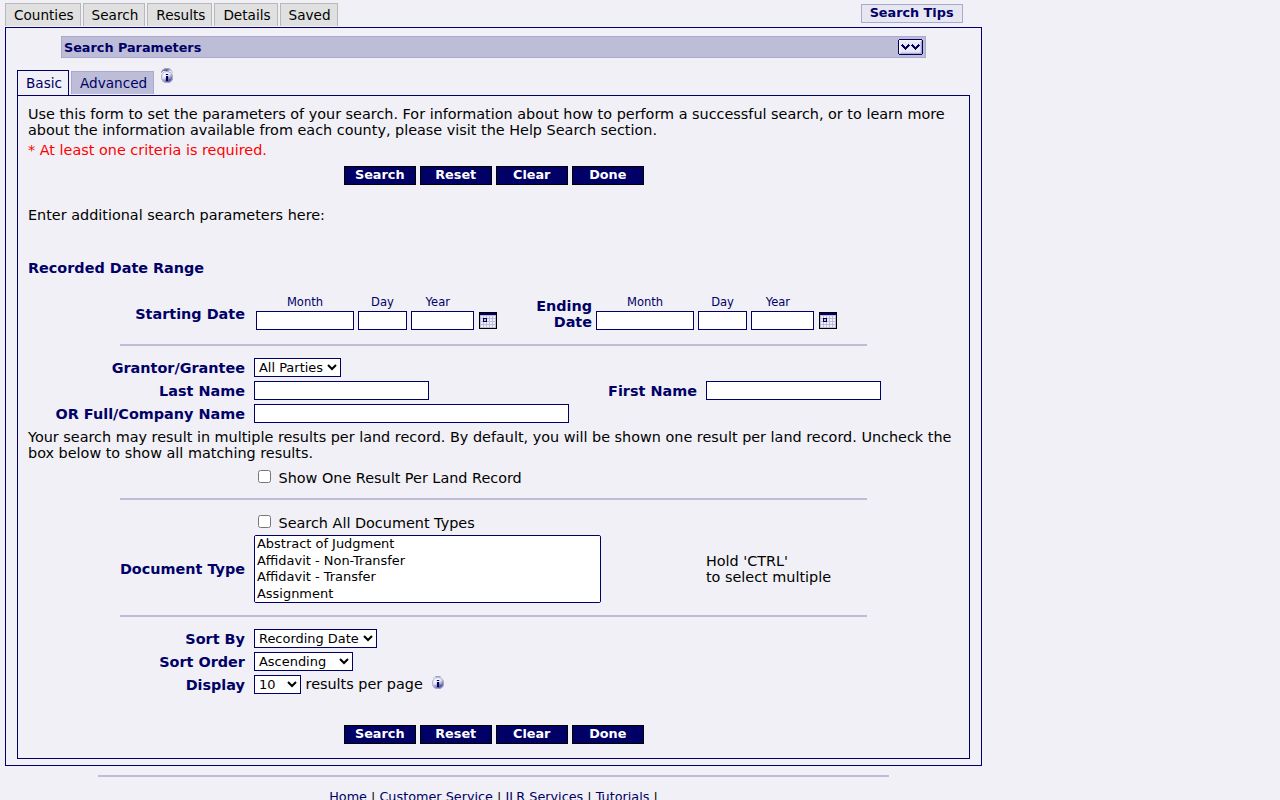
The ILR Search 2.0 form supports county, date, party role, name, image, document type, sorting, and display controls. A blank result does not mean no older deed exists.
Select Clinton County, then widen Clinton dates only as needed. Search both grantor and grantee roles, and inspect repeated Clinton party rows before assuming they are separate transfers. ILR can show one result per Clinton land record or all matching party rows. Search Clinton trust and company names as full names, and try spouse names or initials when the expected Clinton transfer is absent. Save the Clinton instrument number and image status before moving to the next link.
Clinton Previous Residents Before 1986
Clinton County-linked Beacon and ILR notices place the practical Clinton online land-data start around 1986. Earlier Clinton records require a channel switch. The Clinton County Recorder at 1900 North 3rd Street holds official Clinton land material and accepts targeted requests by instrument, document type, or party. The Clinton Auditor's older transfer and plat records, SHSI county series, and FamilySearch microfilm extend the Clinton search.
SHSI lists Clinton County land books from 1840 to 1902 and town-lot indexes or records from 1840 to 1900. The original government-survey field notes from the 1830s are not scanned, but the county says they can be viewed in the Auditor's Plat Room. That offline chain can connect a modern parcel to its earliest surveyed setting.
The Recorder offers another direct fallback. Frame an office request around a known instrument, document type, party, or legal description. Its information-request form warns that supplied information is a service rather than certification, so ask separately if a certified copy is needed. The main Clinton office is open on weekdays, and a DeWitt satellite office has Wednesday hours. Calling first can clarify whether the target is in an index, book, microfilm run, or archival transfer.
Clinton Addresses That Changed Names
Old Clinton addresses do not always line up with today's search box. Bartlett's 1836 plat used the name New York, Clinton was replatted in 1855, Lyons remained distinct before annexation in the 1890s, and a 1969 city ordinance addressed street-name continuity. Camanche, DeWitt, and Vandenburg can also appear in early county references.
When previous residents disappear, search the historic locality, old street form, legal description, block and lot, and nearby directory years. A 1901 sample used a corner description and “(L),” while the 1903 sample used a numbered Lyons address. The change may reflect numbering or publisher style rather than a move.
Clinton County's own history adds another place-name trap. County government moved from Camanche to Vandenburg, renamed DeWitt, and then to Clinton in 1869. An early deed, probate reference, or court item may carry the former seat rather than the present city. Search each historic label, but do not treat the label by itself as proof that the household moved.
Map the Clinton Building Itself
The Library of Congress preserves a July 1890 Clinton Sanborn fire-insurance set of 22 sheets. It can show the street grid, footprint, materials, and historic use around a block. It does not prove ownership or present-day use. Pair the sheet with a directory line and town-lot deed before tying a person to the structure.
For newer work, City permit records in the City Clerk archive reach back to 2008. No public address-keyed permit index was found. Submit a request with the address, parcel, approximate year, and desired fields, such as permit number, scope, issue date, inspection, and final status. Plans may have release limits even when the basic permit record is public.
A permit can date an addition, roof, demolition, renovation, or inspection, but the applicant may be an owner, contractor, or other contact. Keep that role distinct from residence. The City Clerk coordinates the request route, while Building Safety holds the operational permit context. If the search is broad, identify the department and ask whether records can be produced in stages rather than requesting an undefined address file.
Ask Clinton About Previous Residents
Clinton Public Library does not publish a separate house-history guide, but Special Collections can route a focused address request across directories, newspapers, atlases, microfilm, cemetery books, obituaries, and photographs. Contact the second-floor local-history desk with the current address, legal description if known, target era, old street or locality names, and one or two precise questions.
Ask staff to confirm the exact directory year, whether an address-first section exists, and whether a newspaper page can be retrieved remotely. Some FamilySearch images are visible only at an affiliate center, and the Clinton library is a designated center. A narrow request is more likely to identify the right volume or reel than a request for every previous resident across many decades.
Clinton Past Residents Beyond Owners
Deeds identify recorded parties, not every person in a home. Directory entries and open census schedules add the household layer. Work from a known address and compare the closest available years. The publication runs and entry marks are detailed on the Clinton city directory page.
- Transcribe the address and each named person from the nearest directory edition.
- Check the prior and next available year, including address-first arrangements where confirmed.
- Compare the nearest open census, keeping its enumeration date separate from the directory year.
- Search the library newspaper project for a move, marriage, death, estate, or number-change notice.
- Use an obituary, cemetery source, probate file, or vital index to close the trail without guessing relationships.
The county cemetery page maps 86 cemeteries by name or township but does not offer a complete public interment-name search. Library obituary holdings also lack a published year span. Ask Special Collections for the exact index format and coverage, then verify family ties in an original record.
Keep a research log with one row for each source. Note the year, address as printed, person, evidence type, page or instrument number, and confidence level. Mark gaps instead of filling them with assumptions. This makes it clear when two past residents share a surname but not an identity, and when a deed party was an owner without being an occupant.
Lawful use. Research Clinton previous residents for house or family history. Never use an address trail to track, harass, or harm a living person.